Citation: Quinn, D., 1992, Ishmael: New York, Bantam Books
Link to Amazon.com
I never expected to write about fiction on this blog, but here I am! Ishmael is a novel by Daniel Quinn that explores the history of human civilization through a unique perspective that challenges us to reconsider our fundamental relationship with nature and the Earth. The book is deeply philosophical, and the plot built around this philosophy is not overly compelling nor important. That is, the plot is merely a way for Quinn to deliver this philosophy, to get the reader to consider alternative worldviews, to see that many "fundamental" ideas we view as human are really cultural beliefs and are not intrinsically tied to man. The point of the book is to get you to think about the philosophical assumptions that inform the way we live and question whether or not that philosophy is flawed. In other words, Quinn ask us "what if it's not simply a problem of poor execution? What if we are fundamentally approaching man's place on Earth, and man's destiny, incorrectly?"
Typically when I post on this blog I digest the books I review so that readers have a general idea of what they will take away from these titles. In this case, as much I as I really really really want to spill the beans and quote the book incessantly, it's not appropriate. I would ruin the fun for you. I will say that one of the reasons I loved this book so much is that it explores the philosophical and cultural changes necessary to save the planet. An idea I have long held dear is that we need to rely on cultural change, not legislative change, to ensure our long term survival. I also strongly believe that we would generally be a happier people if we adopted this culture, if we enacted this story, as Daniel Quinn would say.
In the spirit of the book, I ask you to consider the following questions (of my own design). If you are interested in the answers, than I suggest reading the book!!
Many of us are familiar with famous explorers such as R. Amundsen, R.F. Scott, and E. Shackleton for Antarctic exploration, correct? Similarly we are aware of E. Hillary and T. Norgay for their ascent of Everest. Why are we so interested in their accomplishments? True, during these expeditions we made some new scientific discoveries, but do we celebrate these discoveries? No, we primarily celebrate the men for their feats. Why did these explorers set out to reach these places in the first place? Is there anything inherently wrong with their reasons for such expeditions? After reading Ishmael, you may answer these questions differently...
Back to non-fiction and my standard style in the next post! Cheers, -James
Monday, March 10, 2014


Monday, January 27, 2014
Book Review: The End of Nature
Citation: McKibben, B., 1989, 2006, The end of nature: New York, Random House, Inc.
Link to Amazon.com
I'm back! A busy fall has kept me from posting in a long while. I have been able to read a few books, but not all were directly related to climate science (Micheal Pollan's In Defense of Food was great!). Really though, I just haven't kept up with my writing, so I should have two posts in the next few weeks. This is the first.
Bill McKibben, now a famous environmentalist (first for his writing, now for his advocacy), wrote The End of Nature in 1988 when popular non-fiction about climate change really didn't exist yet and Rachel Carson's Silent Spring (published in 1962) was still the preeminent piece in the libraries of environmentalists (note that I haven't yet read Silent Spring, but I will soon!). Nowadays The End of Nature is considered a formative work in environmental non-fiction.
Link to Amazon.com
I'm back! A busy fall has kept me from posting in a long while. I have been able to read a few books, but not all were directly related to climate science (Micheal Pollan's In Defense of Food was great!). Really though, I just haven't kept up with my writing, so I should have two posts in the next few weeks. This is the first.
Bill McKibben, now a famous environmentalist (first for his writing, now for his advocacy), wrote The End of Nature in 1988 when popular non-fiction about climate change really didn't exist yet and Rachel Carson's Silent Spring (published in 1962) was still the preeminent piece in the libraries of environmentalists (note that I haven't yet read Silent Spring, but I will soon!). Nowadays The End of Nature is considered a formative work in environmental non-fiction.
Sunday, August 11, 2013
State of the Science: Press Release from AGU
The American Geophysical Union (AGU) just released a statement evaluating the current understanding of climate change, and the need for humans to address this issue. The statement (as a .pdf) is titled "Human-induced climate change requires urgent action." It's only two pages long, so READ IT and, if you so desire, see the press release.
Why does this matter? AGU is one of the largest scientific organizations in the world which focuses on earth, atmospheric, and planetary sciences. It is responsible for the publication of numerous journals, and its annual meeting regularly hosts over 20,000 attendees. Last year there were over 15,000 poster presentations and 7,000 oral presentations (all of this info is available on www.agu.org). Most of these presentations are precursors to articles which get published in peer-reviewed journals. The statement that AGU released represents the cumulative findings from thousands of researchers and their publications. The statement represents the state of the current science of human-induced climate change. So although a 15 member committee drafted this statement, it is supported by the work produced by the >60,000 members of the AGU.
Human-induced climate change is real. Any political nitpicking arguing that uncertainties in research should make us question the need for action are misguided, if not irresponsible. The statement addresses this directly with the following sentences:
While important scientific uncertainties remain as to which particular impacts will be experienced where, no uncertainties are known that could make the impacts of climate change inconsequential. Furthermore, surprise outcomes, such as the unexpectedly rapid loss of Arctic summer sea ice, may entail even more dramatic changes than anticipated.
So, be wary of any political statements claiming that evidence isn't substantial enough to require action. Those statements keep citizens in the dark and money in the pockets of energy corporations.
Why does this matter? AGU is one of the largest scientific organizations in the world which focuses on earth, atmospheric, and planetary sciences. It is responsible for the publication of numerous journals, and its annual meeting regularly hosts over 20,000 attendees. Last year there were over 15,000 poster presentations and 7,000 oral presentations (all of this info is available on www.agu.org). Most of these presentations are precursors to articles which get published in peer-reviewed journals. The statement that AGU released represents the cumulative findings from thousands of researchers and their publications. The statement represents the state of the current science of human-induced climate change. So although a 15 member committee drafted this statement, it is supported by the work produced by the >60,000 members of the AGU.
Human-induced climate change is real. Any political nitpicking arguing that uncertainties in research should make us question the need for action are misguided, if not irresponsible. The statement addresses this directly with the following sentences:
While important scientific uncertainties remain as to which particular impacts will be experienced where, no uncertainties are known that could make the impacts of climate change inconsequential. Furthermore, surprise outcomes, such as the unexpectedly rapid loss of Arctic summer sea ice, may entail even more dramatic changes than anticipated.
So, be wary of any political statements claiming that evidence isn't substantial enough to require action. Those statements keep citizens in the dark and money in the pockets of energy corporations.
Wednesday, July 31, 2013
Book Review: Field Notes From A Catastrophe
Citation: Kolbert, E., 2006, Field notes from a catastrophe: man, nature, and climate change: New York, Bloomsbury USA
Link to Amazon.com
I just finished reading Elizabeth Kolbert's "Field Notes From A Catastrophe: Man, Nature, and Climate Change." Each chapter in "Field Notes" is essentially based off of a different journalistic assignment of Kolbert (she writes for the New Yorker). So in each chapter Kolbert explains why she was in a particular place, recounts her interviews, and adds aditional context so that the reader realizes the gravity of the situation she is investigating. In short the book explores how climate change is already affecting the globe and how it will in the future. Kolbert also explores how politics and big corporations skew our perceptions of global warming, but I'll get to that in a different post. I highly recommend reading this book. It is short, very readable, and compelling.
Link to Amazon.com
I just finished reading Elizabeth Kolbert's "Field Notes From A Catastrophe: Man, Nature, and Climate Change." Each chapter in "Field Notes" is essentially based off of a different journalistic assignment of Kolbert (she writes for the New Yorker). So in each chapter Kolbert explains why she was in a particular place, recounts her interviews, and adds aditional context so that the reader realizes the gravity of the situation she is investigating. In short the book explores how climate change is already affecting the globe and how it will in the future. Kolbert also explores how politics and big corporations skew our perceptions of global warming, but I'll get to that in a different post. I highly recommend reading this book. It is short, very readable, and compelling.
Saturday, July 6, 2013
Book Review: The Little Ice Age
Citation: Fagan, B.M. , 2000, The Little Ice Age: how climate made history, 1300-1850: New York, Basic Books
Link to Amazon.com
In The Little Ice Age, author Brian Fagan explores the role of climate changes in shaping societies. Specifically he examines a period stretching from about 1000 AD to 2000 AD, which encompasses the climatic intervals known as the Medieval Warm Period and the Little Ice Age, and also covers our climate since the industrial revolution. He stresses that his story is not one advocating environmental determinism, but he does argue, convincingly, that changing climatic intervals indeed influenced major shifts in socioeconomic patterns (e.g. in England, the shift from "common" agricultural lands to privately owned farms practicing more diversified agriculture was partly a response to a less favorable climate interval where cereal crops failed more often and the security of a diversified food supply was warranted.). He accomplishes this by uncovering accounts (and in later centuries, measurement) of weather patterns, annual crop yields, fishery reports, changing diets, trade records, disease outbreaks, and occurrences of famine, for all of Europe. His focus is on Western Europe, perhaps because of more available information, but importantly his focus has a wide latitudinal range and he explores changes from Iceland to Spain. At times, some climatic changes would benefit the northern countries while negatively affecting mainland Europe, and vice versa. This of course is due to the complexity of our Earth's climate system, but in some ways the effect of a climate change on a society depends on how well prepared that society is to face it technologically, economically, culturally, and politically. For example, political and cultural systems in France delayed the shift to agricultural diversification and advanced crop rotation for hundreds of years after the Dutch and English transition. This was to the detriment of the French peasantry, who continued to suffer poor cereal harvests and bread shortages as colder and wetter years dominated. This delay was mainly due to 1) the lack of interest/investement in agriculture by French nobility and royalty, and 2) the adherence to cultural/gastronomical norms and the resistance to new food products such as potatoes. Writes Fagan, "no one, whether monarch, noble, or peasant, gave much thought to broadening the diet or of encouraging new farming methods in the face of real declines in productivity (p.155)." Could we experience a similar problem as our population continues to grow?
Link to Amazon.com
In The Little Ice Age, author Brian Fagan explores the role of climate changes in shaping societies. Specifically he examines a period stretching from about 1000 AD to 2000 AD, which encompasses the climatic intervals known as the Medieval Warm Period and the Little Ice Age, and also covers our climate since the industrial revolution. He stresses that his story is not one advocating environmental determinism, but he does argue, convincingly, that changing climatic intervals indeed influenced major shifts in socioeconomic patterns (e.g. in England, the shift from "common" agricultural lands to privately owned farms practicing more diversified agriculture was partly a response to a less favorable climate interval where cereal crops failed more often and the security of a diversified food supply was warranted.). He accomplishes this by uncovering accounts (and in later centuries, measurement) of weather patterns, annual crop yields, fishery reports, changing diets, trade records, disease outbreaks, and occurrences of famine, for all of Europe. His focus is on Western Europe, perhaps because of more available information, but importantly his focus has a wide latitudinal range and he explores changes from Iceland to Spain. At times, some climatic changes would benefit the northern countries while negatively affecting mainland Europe, and vice versa. This of course is due to the complexity of our Earth's climate system, but in some ways the effect of a climate change on a society depends on how well prepared that society is to face it technologically, economically, culturally, and politically. For example, political and cultural systems in France delayed the shift to agricultural diversification and advanced crop rotation for hundreds of years after the Dutch and English transition. This was to the detriment of the French peasantry, who continued to suffer poor cereal harvests and bread shortages as colder and wetter years dominated. This delay was mainly due to 1) the lack of interest/investement in agriculture by French nobility and royalty, and 2) the adherence to cultural/gastronomical norms and the resistance to new food products such as potatoes. Writes Fagan, "no one, whether monarch, noble, or peasant, gave much thought to broadening the diet or of encouraging new farming methods in the face of real declines in productivity (p.155)." Could we experience a similar problem as our population continues to grow?
Thursday, June 27, 2013
Journal Article "Land transformation by humans: A review"
This article comes from the December 2012 issue of GSA Today, the Geological Society of America's monthly journal.
Citation: Hooke, R.L., Martin-Duque, J.F., and Pedraza, J., 2012, Land transformation by humans: A review: GSA Today, v. 22, no. 12, p. 4-10
This is the html link to the article: http://www.geosociety.org/gsatoday/archive/22/12/article/i1052-5173-22-12-4.htm
Synopsis: This is a somewhat odd first choice for my blogging efforts, because it does not address climate change at all, but rather land-use change. However, it's not that odd when you consider the role that changing land-use has on the climate system (e.g. cutting/burning of rain forests takes carbon stored in biota and transfers it to the atmosphere). Perhaps more importantly, the direct impacts of current [unsustainable] land use practices put pressure on us as a species to maintain the necessities of life (high agricultural production rates, access to clean water resources, etc.). With added pressure from rapidly changing climate, our ability to support ourselves (in the biological sense) becomes even less certain. Anyway, this paper draws heavily from previous more quantitative research, and its results depend in some ways on how the authors define terms and what assumptions they make. Importantly, they make conservative estimates and despite this conservatism, determine that "~70 Mkm^2, or >50% of Earth’s ice-free land area, has been directly modified by human action involving moving earth or changing sediment fluxes. Many of these activities have indirect consequences well beyond the area directly affected." Implicit in this statement is that much of this modification by human action has negatively affected the land. That aside, the authors look at the rates at which we modify land and determine that, given our current population and land-use patterns, we are almost certainly operating beyond our biological carrying capacity. If we are not currently in overshoot, then the current rate of population growth will certainly bring us to that point within the next century or two. Like any other species, we will adapt to this condition of overshoot by first experiencing a decline in the standard of living, and then, secondly, by reducing the population (read: more people die of starvation and disease and less children are born).
Citation: Hooke, R.L., Martin-Duque, J.F., and Pedraza, J., 2012, Land transformation by humans: A review: GSA Today, v. 22, no. 12, p. 4-10
This is the html link to the article: http://www.geosociety.org/gsatoday/archive/22/12/article/i1052-5173-22-12-4.htm
Synopsis: This is a somewhat odd first choice for my blogging efforts, because it does not address climate change at all, but rather land-use change. However, it's not that odd when you consider the role that changing land-use has on the climate system (e.g. cutting/burning of rain forests takes carbon stored in biota and transfers it to the atmosphere). Perhaps more importantly, the direct impacts of current [unsustainable] land use practices put pressure on us as a species to maintain the necessities of life (high agricultural production rates, access to clean water resources, etc.). With added pressure from rapidly changing climate, our ability to support ourselves (in the biological sense) becomes even less certain. Anyway, this paper draws heavily from previous more quantitative research, and its results depend in some ways on how the authors define terms and what assumptions they make. Importantly, they make conservative estimates and despite this conservatism, determine that "~70 Mkm^2, or >50% of Earth’s ice-free land area, has been directly modified by human action involving moving earth or changing sediment fluxes. Many of these activities have indirect consequences well beyond the area directly affected." Implicit in this statement is that much of this modification by human action has negatively affected the land. That aside, the authors look at the rates at which we modify land and determine that, given our current population and land-use patterns, we are almost certainly operating beyond our biological carrying capacity. If we are not currently in overshoot, then the current rate of population growth will certainly bring us to that point within the next century or two. Like any other species, we will adapt to this condition of overshoot by first experiencing a decline in the standard of living, and then, secondly, by reducing the population (read: more people die of starvation and disease and less children are born).
Tuesday, June 15, 2010
Saying Goodbye to New Zealand - Mt. Oxford
Hey All,
It's been a while since my last post, and for that I apologize. I've been busy with the end of the semester and exams, and the winter season had brought a lot of bad weather that has prevented me from getting out into the great NZ outdoors. Being on campus so much this past month has allowed me to spend a lot of time with the friends that I have made here, and it has been a lot of fun. This may be to my detriment, however, as it will make leaving my friends all the more difficult, and will make my homecoming somewhat bittersweet. To be honest, I don't think leaving New Zealand will be that hard - just leaving my friends will be difficult (who are all North Americans coincidentally). I'm ready to come home and feel very much done with NZ this time round. I've enjoyed my time and there are still a few things I wish I could have done, but now I have an excuse to come back here someday...
Exams went well and my classes were pretty satisfying and rewarding overall. I was disappointed by viticulture somewhat, but you can't win them all I guess. Anyway, having been done with exams for almost a week now, I've been able to do some souvenir shopping and some relaxing with friends. I've also been able to support the Celtics and enjoy my last few NZ beers - keep your fingers crossed for Game 7!
Today, I took my last hike in NZ. My friend Sam and I headed up to Mt. Oxford, which is a small mountain in the eastern foothills of the Southern Alps. To the west are some spectacular peaks, and Oxford provided some great views of them. Being so late in the season here, the alps were all covered in snow, and Oxford had about 4 inches of snow before we stopped for lunch. We were without crampons or snowshoes, so we decided against making the final push to the summit, where the snow was much deeper. It still made for a great day hike, and I think rounded out my NZ outdoors experience pretty well - I had yet to see the mountains all covered in snow (except for the highest peaks of course), and it made the landscape even more magnificent. I hope you enjoy the pictures:
I leave in less than 3 days, and its amazing that I've been here for four months already. I think I've learned a lot in this time; about people, about soil science, about New Zealand, and most about myself. I'm looking forward to coming home, and I can only hope America is looking forward to having me back....
Thanks for following me all this time,
-James
It's been a while since my last post, and for that I apologize. I've been busy with the end of the semester and exams, and the winter season had brought a lot of bad weather that has prevented me from getting out into the great NZ outdoors. Being on campus so much this past month has allowed me to spend a lot of time with the friends that I have made here, and it has been a lot of fun. This may be to my detriment, however, as it will make leaving my friends all the more difficult, and will make my homecoming somewhat bittersweet. To be honest, I don't think leaving New Zealand will be that hard - just leaving my friends will be difficult (who are all North Americans coincidentally). I'm ready to come home and feel very much done with NZ this time round. I've enjoyed my time and there are still a few things I wish I could have done, but now I have an excuse to come back here someday...
Exams went well and my classes were pretty satisfying and rewarding overall. I was disappointed by viticulture somewhat, but you can't win them all I guess. Anyway, having been done with exams for almost a week now, I've been able to do some souvenir shopping and some relaxing with friends. I've also been able to support the Celtics and enjoy my last few NZ beers - keep your fingers crossed for Game 7!
Today, I took my last hike in NZ. My friend Sam and I headed up to Mt. Oxford, which is a small mountain in the eastern foothills of the Southern Alps. To the west are some spectacular peaks, and Oxford provided some great views of them. Being so late in the season here, the alps were all covered in snow, and Oxford had about 4 inches of snow before we stopped for lunch. We were without crampons or snowshoes, so we decided against making the final push to the summit, where the snow was much deeper. It still made for a great day hike, and I think rounded out my NZ outdoors experience pretty well - I had yet to see the mountains all covered in snow (except for the highest peaks of course), and it made the landscape even more magnificent. I hope you enjoy the pictures:
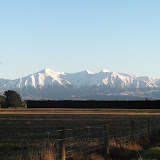 |
| Mt. Oxford |
I leave in less than 3 days, and its amazing that I've been here for four months already. I think I've learned a lot in this time; about people, about soil science, about New Zealand, and most about myself. I'm looking forward to coming home, and I can only hope America is looking forward to having me back....
Thanks for following me all this time,
-James
Subscribe to:
Comments (Atom)